





By Brett Miller, NWFA Vice President Technical Standards, Training & Certification
Real wood is the only flooring material that responds to its environment on a daily basis. It expands and contracts constantly, but most of these changes are subtle and not noticeable to the naked eye. Some wood distortions, however, are very noticeable. Although these distortions can seem problematic, some are not a need for concern and can be corrected with minimal effort. Two common wood distortions that often can be corrected include warp and buckling.
Warp
Identification
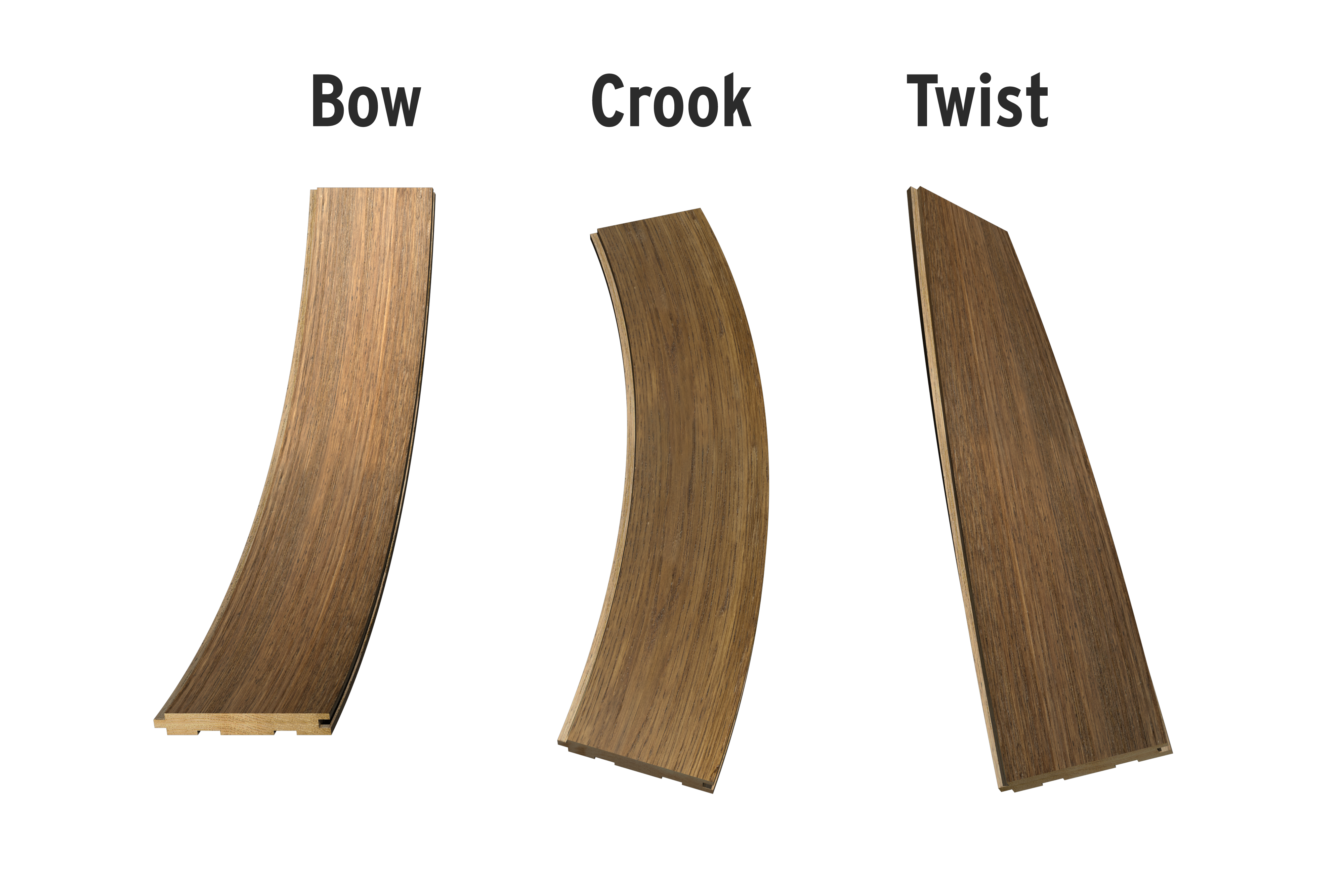
Warp is defined as any variation of the intended shape of a piece of wood flooring from a true or flat plane. Warp generally occurs in one of three ways: bow, crook or twist.
Bow
Identification
Bow is a deviation in the lengthwise flatness of a board, measured end to end.
In solid wood flooring, bow occurs when one side of the floor board shrinks more in length than the other. It causes a lengthwise curvature of the plank that resembles a bow used in archery. Because longitudinal shrinkage in solid wood is minimal, bow normally is not an issue that affects installation.
In engineered wood flooring, bow occurs when the wear layer and the core begin to shrink in opposing lengthwise directions, forcing the uninstalled planks to bow. Manufacturer and industry standards (HPVA) dictate tolerances and milling requirements for the amount of bow allowed in an engineered wood floor at the time of manufacture. This may or may not coincide with uninstalled flooring at the jobsite due to a change in moisture content.
Crook
Identification
Crook is a deviation in the end-to-end straightness along the edge of a board. It sometimes is referred to as “side-bend.” Crook occurs when one edge of solid flooring shrinks more in length than the other, due to the characteristics of the wood in relation to the orientation of the grain.
Twist
Identification
Twist is a deviation where the four corners of a board face are no longer in a flat plane.
Causes
- Wood is an anisotropic material, meaning it will shrink/swell in relation to its grain orientation. The extent to which solid wood shrinks, swells or changes shape also is related directly to its size and how it was cut from the It is not uncommon to see one side of a board shrink or swell more or less than the opposite side of the board when seasonal or moisture conditions change, which may result in a slightly warped appearance.
- Improper or unmanaged handling of the environmental conditions surrounding the flooring material after it was manufactured, either during transport, while in storage, while acclimating at the jobsite, or from opened or damaged packaging.
- May be the result of engineered flooring manufactured out of balance (core and wear layer having an unbalanced equilibrium moisture content).
- Inconsistent moisture content.
Cures
For uninstalled flooring:
- Ensure the jobsite environment and the wood flooring moisture content are compatible before installation.
- Cut the material into shorter sizes and use as starters/finishers during the installation.
- Cull objectionable material and do not install those boards.
For installed flooring:
- Replace affected boards as necessary.
- Perform aesthetic repairs; use fillers or slivers, and blend with remaining floor.
Buckling
Identification
Buckling is defined as the wood flooring separating or lifting from the subfloor.
Causes
- An increase in moisture conditions. Potential sources of moisture may include the following:
- Inadequate or inoperable HVAC systems resulting in elevated humidity levels.
- Wet subflooring (wood or concrete slab).
- Inadequate moisture control systems installed beneath the wood floor.
- Poor building drainage resulting in rainwater runoff or subsurface groundwater.
- Moisture from inadequately ventilated or unconditioned crawl spaces or basements.
- Portable water sources/appliances, building leaks or plumbing leaks.
Maintenance-related conditions, including the following:
- Wet-mopping resulting in standing/topical liquid moisture left on the floor.
- Use of steam mops/cleaning devices.
- Use of non-breathable rugs on the floor.
- Not maintaining relative humidity levels year-round to support the installed flooring.
- Factors that may aggravate the problem include these improper installation techniques:
Nail-down wood floors:
- Improper acclimation/conditioning of the flooring and the building.
- Inadequate perimeter or expansion space at all vertical obstructions, or internal expansion space (washer rows) within the The recommended expansion space may have been adequate at the time of installation and closed due to environmental changes.
- Inadequate nailing schedule.
- Incorrect fasteners used.
- Incorrect or inadequate subfloor material.
- Non-elastomeric adhesive used under the wood flooring at perimeters/pull-up walls or within the floor The wrong adhesive can restrict natural flooring movement, thus creating an anchor within the flooring system.
Glue-down wood floors:
- Improper acclimation/conditioning of the flooring and the building.
- Inadequate perimeter expansion space at vertical obstructions. The recommended expansion space may have been adequate at the time of installation and closed due to environmental changes.
- Inadequate internal expansion spacing (washer rows) within the floor. The recommended expansion space may have been adequate at the time of installation and closed due to environmental changes.
- Improper application of adhesive.
- Incorrect adhesive.
- Insufficient adhesive.
- Wrong trowel used to apply the adhesive.
- Inadequate adhesive transfer.
- Poor subfloor preparation.
- Subfloor contamination.
- Floor not approved by the wood flooring manufacturer to be glued down.
Floating wood floors:
- Improper acclimation/conditioning of the flooring and the building.
- Inadequate perimeter expansion space at vertical obstructions. The recommended expansion space may have been adequate at the time of installation and closed due to environmental changes.
- Pinch points caused by door jams, door stops, closet tracks, baseboards, trim, or adhesive caulking restricting lateral movement.
- Heavy (or fixed in place) furniture or cabinets restricting lateral movement.
- Flooring length and/or width exceeding manufacturer’s requirements.
- Lack of, missing or improperly installed transitions.
Cures
- Identify and eliminate the source of moisture.
- In some cases, this will require the use of dehumidification systems to stabilize the ambient conditions and bring them to within the acceptable target range.
- Flooring and subflooring must be allowed to dry to what would be considered “normal levels” for the area before any repairs take place.
- Maintain the environment within the flooring manufacturer’s When conditions are not specified by the manufacturer, maintain temperature between 60 to 80 degrees Fahrenheit (15.6 to 26.7 degrees Celsius), and relative humidity between 30% to 50%.
- Release stress on the floor by providing relief at vertical obstructions.
- Removal and replacement of the affected area often is necessary.
The National Wood Flooring Association has detailed information about wood flooring distortions and corrections available through NWFA University, an online training platform that is convenient and affordable. More information is available at nwfa.org/nwfa-university.aspx.


