





By Grete Heimerdinger, Lignomat
Understanding moisture behavior in wood flooring is critical for successful installation and accurate inspection. Two essential concepts guide this understanding: Equilibrium Moisture Content (EMC) and the Moisture Map of North America. While closely related, they serve different purposes.
First, installers and inspectors must understand what EMC is. Second, they must know how to apply that knowledge in real-world conditions, which is where the Moisture Map becomes invaluable. However, no chart or map can replace the experience and judgment of the professional on–site, who must determine whether conditions are suitable for installation—or identify the root cause of a flooring problem.
This article addresses three key questions:
- What is EMC?
- Why is the Moisture Map important?
- What do EMC and the Moisture Map mean for installers and inspectors?
What Is EMC?
Relative Humidity, Temperature and Moisture Content
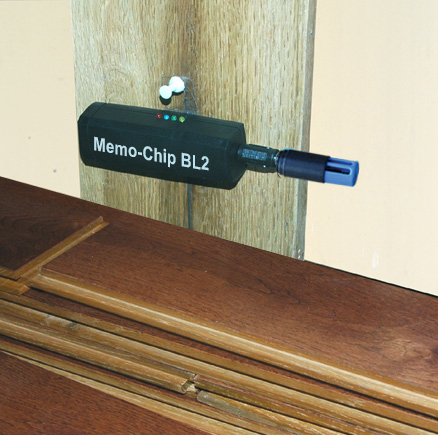
It is a well-established fact that changes in relative humidity (RH) cause changes in wood moisture content (MC). When moisture content changes, wood responds by expanding or contracting, which can result in shrinking, warping, cupping or twisting. The degree of movement depends on the wood species, grain pattern and the amount of moisture change.
The goal is to reach a stable condition, where the wood’s moisture content is in balance with the surrounding environment. This condition is known as Equilibrium Moisture Content (EMC). When wood is at EMC, it neither gains nor loses moisture and dimensional changes stop.
The EMC chart defines this relationship. For every combination of RH and ambient temperature, there is a corresponding moisture content at which the wood is stable.
According to the U.S. Department of Agriculture Wood Handbook Wood as an Engineering Material, recommendations for RH in buildings range from 30% – 50% and for ambient temperatures range from 60°F – 80°F. If ambient conditions stay within the recommended ranges, the EMC of wood should stay between 6% and 9%. Should the moisture content change within the given range, the amount of expansion and contraction of the wood should be limited.
Examples:
1) If kept at 40% RH and a temperature of 70°F, lumber at 7.7% will not change its moisture content.
2) If conditions in a warehouse are 60% RH at 50°F and dry wood is left in the warehouse for an extended period, the wood will pick up moisture until 11.2% wood moisture is reached, regardless of wood species and initial moisture content.
The EMC chart provides the correlation between moisture content and ambient RH and temperature. Wood is stable at the given moisture and RH ranges. See the chart at: https://lignomatusa.com/emc-equilibrium-moisture-content/
For info on the MC Tracker, a datalogger which measures moisture content, relative humidity, temperature and EMC, visit https://lignomatusa.com/product/mc-tracker-data-logger-monitor-moisture/
Why the Moisture Map of America is Important
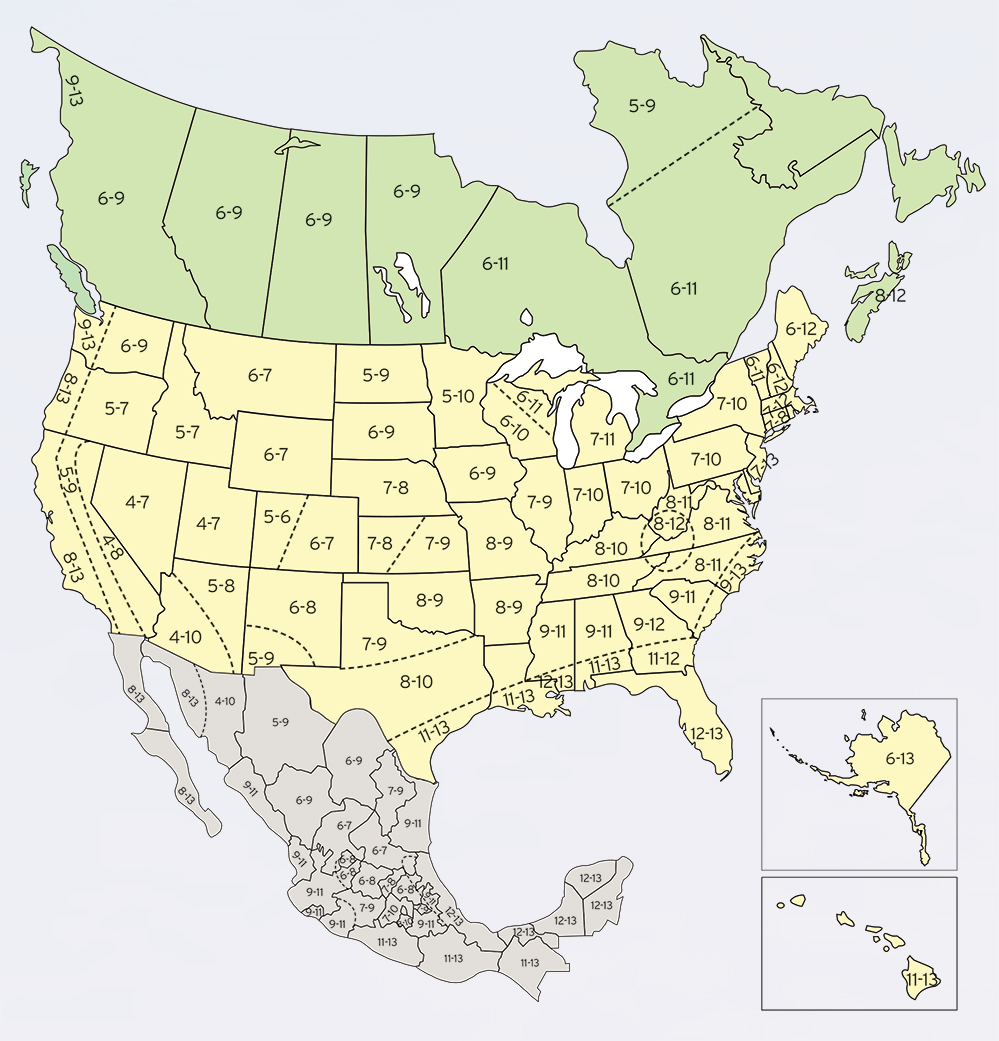
The map illustrates how EMC levels vary throughout the year across different climate zones. This is an important consideration because wood continually exchanges moisture with the surrounding air.. Regional and seasonal differences directly influence wood movement and dimensional stability. Understanding these patterns helps installers, inspectors, and facility managers anticipate and manage potential moisture-related issues.
Published with permission from the National Wood Flooring Association (NWFA), the map provides a valuable reference for understanding regional moisture trends. While actual job-site conditions may differ, the map establishes important baseline expectations for wood performance.
The map highlights both regional averages and seasonal fluctuations. Here are some examples
- Florida experiences consistently high RH, resulting in EMC levels of approximately 12–13% year-round, with very little seasonal variation.
- Utah maintains low RH throughout the year, producing stable EMC levels of about 5–6%.
- Minnesota has humid summers and cold, dry winters, leading to significant seasonal swings in EMC—ranging from roughly 5% in winter to 10% in summer.
- Arizona includes regions with wide seasonal variation, where EMC levels can fluctuate from about 4% to 10% depending on the time of year.
Wood is stable when the moisture content of the wood is the same as the EMC, determined by the RH and the temperature surrounding the floor.
Find out more about the Moisture Map at https://lignomatusa.com/moisture-map-of-north-america/
What Does This Mean for Installers and Inspectors?

One indispensable tool for installers and inspectors is an accurate wood moisture meter. However, measuring moisture content alone is not sufficient to fully understand site conditions or predict wood performance. To gain a complete picture, RH must also be measured. What matters most is the relationship between moisture content and RH, as this correlation determines whether wood will remain stable or undergo dimensional changes.
Wood remains stable only when environmental conditions fall within the ranges defined by the EMC Chart. When RH fluctuates outside these limits, the moisture content of wood changes accordingly and can lead to expansion, contraction, cupping, warping or other forms of movement.
For this reason during acclimation, installation and inspection, both RH and moisture content must be accurately measured and properly documented. Monitoring these values over time ensures that materials have reached equilibrium with their environment before installation and helps identify environmental causes when issues arise later.
Consistent recordkeeping not only provides critical protection for installers by demonstrating due diligence, but it also gives inspectors the clarity needed to accurately diagnose moisture-related problems. Without reliable data, determining responsibility or root cause becomes far more difficult. By combining precise measurement with proper documentation, professionals can make informed decisions, ensure long-term performance and protect both their work and their reputation.
This is why moisture meters and thermo-hygrometers are essential tools for flooring and building professionals. A comprehensive solution—such as the Ligno-VersaTec Kit with thermo-hygrometer—allows professionals to:
- Accurately measure moisture content in wood and other building materials
- Measure ambient relative humidity and temperature conditions
- Verify compliance with EMC requirements
- Document conditions throughout the project lifecycle
- Reduce the risk of moisture-related failures and costly callbacks
- Maintaining the floor
When signing off on an installation, it should be explained to the building owner and maintenance crew that certain environmental conditions must be maintained. Review the EMC chart with them and highlight an extreme example to illustrate the impact of RH. For instance, if the wood floor moisture content (MC) is 6% and the RH changes from 35% to 75%, the moisture content will change until it reaches approximately 12%. This demonstrates how critical it is to keep RH within a narrow, controlled range to prevent unwanted moisture movement and to keep the warranty valid.\
Understanding EMC, correctly interpreting the Moisture Map of America, and combining that knowledge with accurate on-site measurements form the foundation of long-lasting wood flooring installations and reliable inspections.
The next Measuring Moisture article will be about selecting the right meter, as well as the pro and cons of pin versus pinless measurements.
For more information, visit https://lignomatusa.com/


